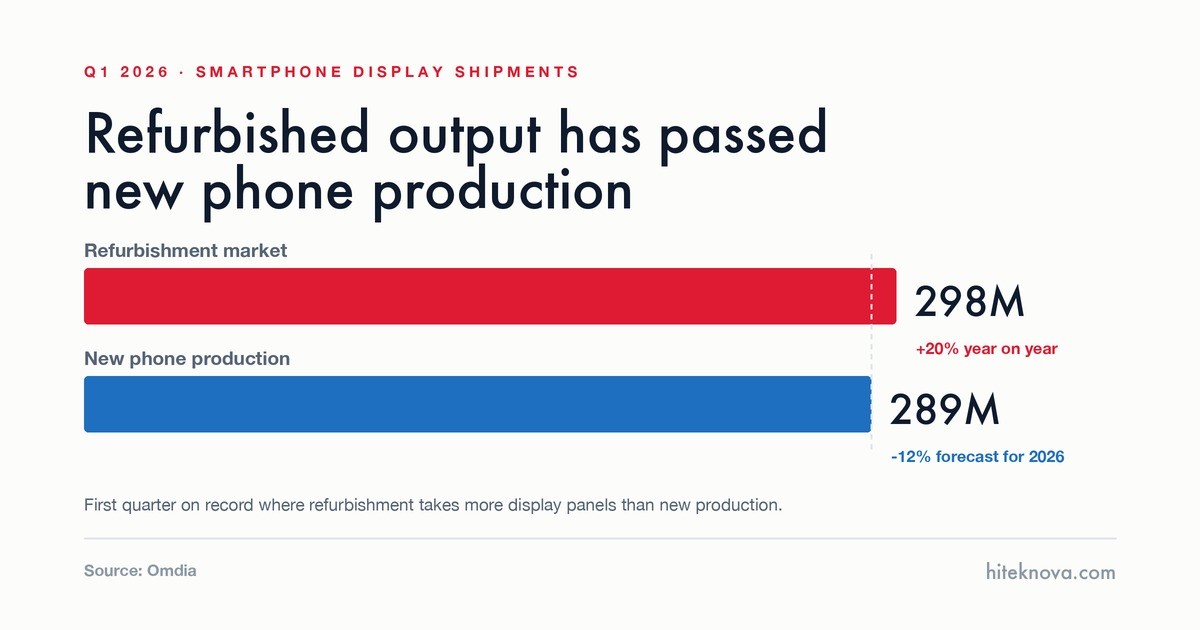
Something crossed over in Q1 2026 that the industry hasn't seen before. According to Omdia, display panel shipments to the refurbishment market reached 298 million units in the first quarter — surpassing the 289 million panels shipped to smartphone manufacturers for new device production.
It is the first time refurbished volume has overtaken new production. And it is not a blip.
What is driving this
High memory costs forced smartphone manufacturers to cut new phone output. Omdia expects new smartphone display demand to fall 12% for the full year 2026, while refurbishment display shipments grew 20% year on year in Q1. The supply side of the new phone market contracted; the refurbishment side expanded to fill the gap.
Omdia analysts describe refurbishment as a "reservoir" capable of absorbing the fluctuations that hit new device manufacturing. When memory prices spike and OEM production drops, used device supply keeps flowing.
What it means in practice for refurbishers
More volume is good news for the trade. But it also raises the bar on every part of the processing workflow.
When throughput was 50 devices a day, a missed test or an incomplete wipe was an isolated event. At 298 million panels in a single quarter across the industry, individual mistakes accumulate — in returns, customer disputes, and in the compliance picture that comes from handling that much consumer data.
Buyers on Back Market, eBay Refurbished, and direct enterprise channels expect certified test records and documented erasure on the devices they purchase. An IMEI check is not optional. A wipe certificate is expected.
The processing quality challenge
The practical problem for small and mid-size refurbishers is that workflows often don't scale cleanly with volume. Manual grading, factory resets that don't constitute certified erasure, and paper or spreadsheet records break down when throughput climbs.
A device graded inconsistently is a return or a dispute. A device "wiped" by factory reset still carries recoverable data — a liability under GDPR and under state-level US privacy laws. A missing wipe certificate is a problem when a business customer asks for it after the fact.
Processing at scale without a bigger team
testPod is built for this operating environment: higher volume, smaller staff, no room for manual errors.
Each device goes through 30+ automated tests — digitizer, LCD, cameras, audio, sensors — and receives a Cloud Diagnostics & Erasure Certificate tied to its IMEI, viewable at hiteknova.com/results/[IMEI] or via the QR label on the device. Erasure is ADISA AAL Level 3 certified (certificate ADPC251, valid until September 2027) — the same certification tier required for regulated data destruction. testPod also wipes locked Samsung devices.
An operator running testPod can process 40–60 phones per hour through background pipelining — not by rushing individual tests, but by moving to the next device while the previous one completes its checks. It runs on your existing computers; no proprietary hardware to buy.
The cost is $30/month per computer, which includes the first 100 devices. Above that, pricing starts at $0.30 per device, with volume bands down to $0.05 per device at scale.
If you want to see how it fits your workflow before committing, there is a free 14-day trial — 25 devices, no card required.