For anyone buying, repairing, or reselling used phones in Europe, July 31, 2026 was a meaningful date. That is when the EU Right to Repair Directive became enforceable across all 27 member states — and smartphones and tablets are explicitly on the list of covered products.
The law has been years in the making, but it is now in effect. Here is what actually changed, and why it matters if you run a phone refurbishing or recycling operation.
What the directive requires
From July 31, 2026, manufacturers of smartphones, tablets, and several other product categories have four core obligations:
- Repair at a reasonable price. Manufacturers must offer repairs even after the legal guarantee period expires. Pricing cannot be set so high that it effectively deters customers from choosing repair over replacement.
- Spare parts for years, not months. Parts must be kept available for a defined period after the last unit of a model is sold — 5 to 10 years depending on product category. Those parts must be priced to make repair realistic, not prohibitive.
- No repair obstruction. Software locks, hardware restrictions, and contractual terms that block independent repairs are now explicitly prohibited. Manufacturers cannot restrict who can do the repair or prevent the use of compatible third-party parts.
- Published information. Manufacturers must maintain publicly accessible pages covering their repair services, pricing guides, and access to repair manuals and diagnostic tools.
There is also a warranty benefit for consumers: if someone chooses to repair a product rather than replace it under the legal guarantee, the seller's liability automatically extends by an additional 12 months.
What this means if you refurbish or recycle phones
The immediate effect for the secondary market is more parts access and fewer legal roadblocks for independent repairers.
For years, some manufacturers used software restrictions to make independent repair difficult — flagging devices as "not genuine" after third-party screen or battery replacements, for example. The directive directly prohibits that in the EU. Independent refurbishers now have clearer legal ground when they encounter those barriers.
The spare parts obligation matters too. With manufacturers required to stock parts for years after a model's last sale, devices that previously had to be scrapped for lack of components become viable repair and resale candidates. That expands what a refurbishing operation can economically process.

The trade-off: more repairable devices means more volume entering the secondary market. Buyers on platforms like eBay Refurbished and Back Market already require documented grading and certified erasure. As supply increases, the operations that can process and document at scale will be better positioned than those still relying on manual spot checks.
Erasure is not an afterthought
One part of the directive that is easy to overlook: manufacturers must publish access to diagnostic tools. That is useful for repair. But it does not solve the data security question on devices coming in from consumers or corporate trade-ins.
A factory reset is not certified erasure. Regulatory expectations — including GDPR in the EU — require that data be provably gone, not just reset. For any device that carried personal or corporate data, certified erasure is the only defensible step before resale.
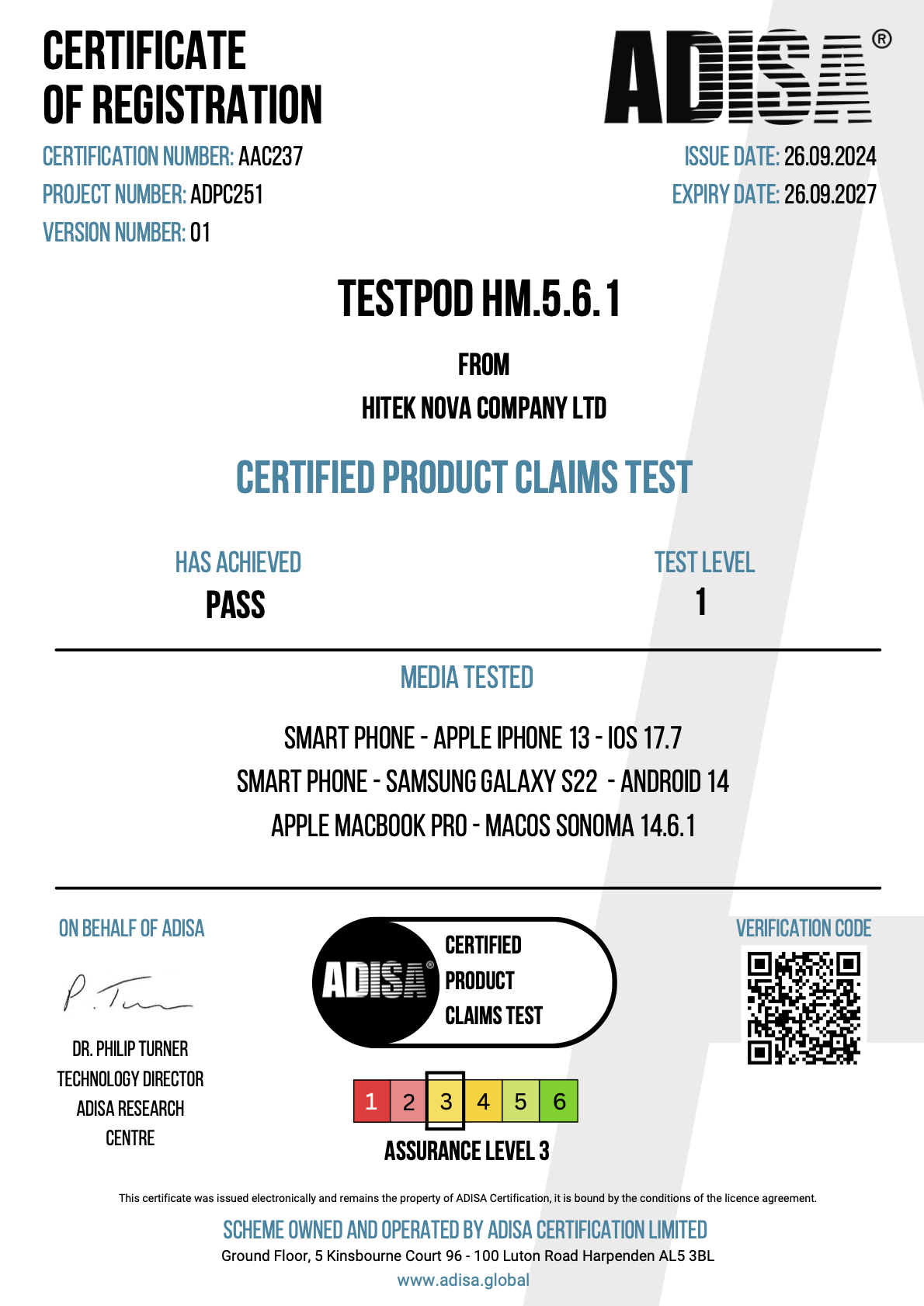
testPod holds ADISA AAL Level 3 certification (Certificate ADPC251, valid to September 2027) — the same certification tier as the largest erasure vendors in the industry. Every device processed issues a cloud-based Diagnostics and Erasure Certificate, viewable at hiteknova.com/results/[IMEI] or via QR label scan. That certificate is what your buyers, your business customers, and your compliance requirements are actually asking for.
Processing volume without adding headcount
As the EU repair directive increases the number of economically viable devices in the market, the processing question becomes practical: how do you handle more volume without hiring proportionally?
testPod runs on your existing computers — no proprietary hardware needed. An operator running the background pipelining workflow can process 40 to 60 phones per hour, covering 30+ hardware tests: digitizer, LCD, front and rear cameras, audio output and microphone, sensors, and more. Results feed directly into grading, labels, and export — no re-entry required.
Pricing is $30 per month per computer, which includes 100 device checks. Above that, checks run from $0.30 per device, with volume bands down to $0.05 at scale. There is no annual contract, no minimum commitment, and no proprietary hardware to purchase.
If you are a European refurbisher evaluating how to handle the volume that the right-to-repair landscape is opening up, a free 14-day trial — 25 devices, no card required — is the fastest way to see if testPod fits your workflow.